

In the virtual reality industry, AI has countless applications. Your mind probably jumps straight to gaming, and for good reason. AI’s role in games is both obvious and powerful, enabling in-game characters to react to players in unexpected ways and formulate responses in real time. Entire levels and environments can be procedurally generated, ensuring a unique experience with every playthrough. This not only deepens immersion but also boosts replayability. Beyond gameplay, AI streamlines development, with procedural generation speeding up asset and environment creation. Game developers are still only scratching the surface of how AI can enhance their creations, paving the way for experiences that resonate deeply with players.
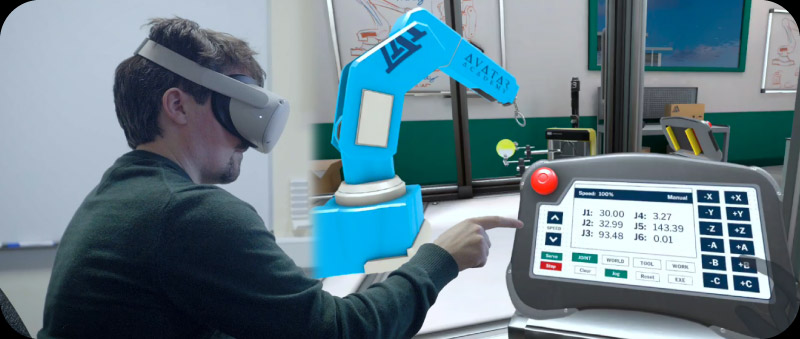
AI supporting Education and Training
At Mersus, however, we’re more focused on the potential of AI for VR training and industry. Here, AI’s impact could be even more transformative. In this blog, we’ll explore how AI is, and will be, integrated into VR training platforms and apps, as well as share some of our own research and developments.
Early forms of AI have already found a place in educational apps. Take Duolingo’s mascot owl, for example, which nudges you when it’s time to practice Spanish. The app’s AI tracks your progress, suggesting when to revisit tricky topics or skip ahead if you’ve mastered the material. This kind of adaptive learning makes the app more effective, and keeps users engaged.
As AI models grow more sophisticated, we expect VR training to incorporate far more advanced educational assistants. These assistants would track a user’s entire learning history, tailoring recommendations based on their goals, or could be customised to their employer’s requirements or industry regulations. The system could provide personalised learning paths and adaptive difficulty levels. It could incorporate competency-based progression, and only unlock advanced training once foundational skills were mastered, ensuring no gaps in knowledge. The potential for a truly personalised learning assistant to help people gain and keep on top of relevant skills is powerful.
Our Work on Intent Recognition
One area of AI integration in virtual reality we’re actively exploring is intent recognition (also known as intent classification). A core part of Natural Language Understanding (NLU), intent recognition identifies the goal behind a user’s input, enabling systems like chatbots and virtual assistants to deliver accurate responses. Traditionally, chatbots rely on typed queries, but in VR, we’re pairing intent recognition with natural language processing. Imagine conversing with an NPC tutor in a training app, asking for details about a process or product. We will also incorporate voice commands into our VR creation app to build VR environments and scenarios. Combined with hand tracking, voice control will streamline VR development, making it faster and more intuitive than ever.
AI making virtual Reality Apps more Responsive and Useful
Imagine a VR welding simulator where an AI instructor watches your technique and instantly says, “Adjust your angle by 10 degrees, you’re overheating the joint.” Or a medical drill where AI detects hesitation during a virtual procedure and pauses to replay the critical step. With biometric tracking (like eye movement and heart rate), AI could even identify stress or distraction and adjust the training pace.
For team-based training, like emergency response, AI can populate VR with realistic teammates who react unpredictably. A firefighter in VR might face an AI teammate who suddenly collapses from smoke inhalation, forcing quick decisions under pressure.
Training for rare emergencies (like oil rig blowouts or cyberattacks) is tough, because they’re rare. AI can simulate these edge cases in VR, so workers learn to respond without real-world risks.
New Solutions to Complex Tasks
The fusion of AI and VR isn’t just changing training, it’s redefining what’s possible. From adaptive learning paths that respond to individual strengths, to AI teammates who mimic real-world chaos, to voice-enabled tools that let trainees (and developers) speak their way through complex tasks, this technology is breaking the limits of traditional training. And we’ve only scratched the surface.
At Mersus, we’re not just watching this revolution unfold; we’re building it. Our work in intent recognition, real-time coaching, and AI-generated scenarios is already helping industries train smarter, safer, and faster. But the real magic happens when these tools are tailored to your needs.
Let’s Build Your Immersive Training Solution
Whether you’re preparing workers for high-risk environments, upskilling teams with hands-on practice, or designing certification programs that adapt to every learner, Mersus can help.
Our VR solutions are:
- Customisable: Need a welding simulator with real-time feedback? A medical drill with AI-generated unpredictability? We’ll design it.
- Scalable: From small teams to enterprise deployments, our tools grow with you.
- Proven: Cut training time, reduce risks, and boost retention – with data to prove it.