
What if the biggest barrier to VR learning wasn’t the lesson itself, but the device?
At Mersus, we’ve believed it for a long time: hand tracking is the game changer.
From the very beginning, we’ve argued that the fastest GPU, the highest resolution, and the most realistic textures mean nothing if the person using it has to first figure out which button does what. We know that if a learner is thinking about the controller, they aren’t thinking about the task. If they are fumbling for buttons, they aren’t absorbing the lesson. Hand tracking doesn’t just make VR more convenient; it makes VR more human. And human is the only interface that works for everyone.
Now, we have the words to prove it.
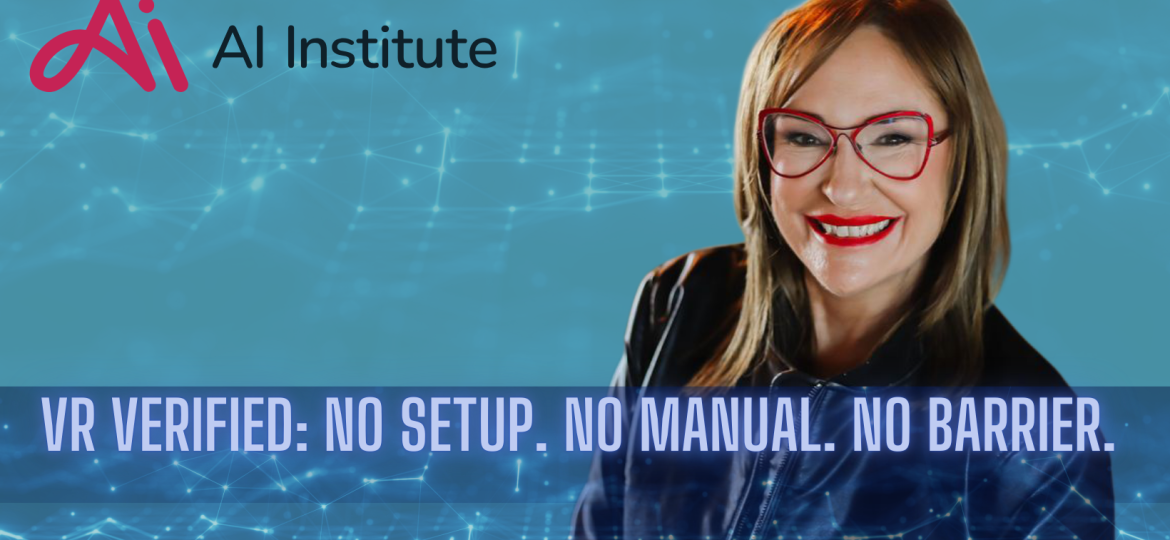
Mary Rose Lyons, founder of the AI Institute and an end-to-end AI adoption specialist, recently stepped into one of our virtual worlds. She didn’t come with a background in VR training or a technical brief to assess our hardware. She came as a learner. More importantly, she came as someone who had experience of clunky interface getting in the way of her use of technology (in this case, for gaming rather than training)
For leaders responsible for upskilling teams in an age of digital fatigue, the challenge is clear: how do you deliver deep, lasting learning when your audience is increasingly resistant to traditional formats? It’s not about producing more content; it’s about removing the friction between the learner and the knowledge.
Mary Rose recently explored this question firsthand. By stepping into a highly detailed virtual world, she didn’t just see a new training tool, she recognised the exact conditions required for human potential to “really shine through.”
Her takeaway? If the interface gets in the way, the lesson is lost. But when the technology disappears, learning becomes inevitable.
If You Have to Learn the Device, You’ve Already Lost the Lesson.
For those of us designing learning experiences, we often focus on the curriculum. But Mary Rose’s perspective, shaped by her past as a top-tier gamer, reframes the priority entirely. She quit gaming because of controllers becoming too complicated.
That same friction applies to learning today. As she put it: if she “had to learn something through a device” she first had to understand, the lesson would be lost.
This is where true immersion changes everything. Watching her explore the virtual world, she described the experience as “amazing” precisely because actions were performed through her own hands. No controller to master. No buttons to map. Just intuitive interaction. That removal of obstacles isn’t a convenience; it’s the foundation of effective learning.
Post-COVID, 2D is “Dead.” Immersion is the Antidote.
We talk a lot about the shift from passive to active learning. Mary Rose articulated the urgency of this shift with striking clarity.
In her view, pre-recorded video is “dead.” She explained that, post-COVID, nobody wants to watch 2D material that “has been done a long time ago.” While her organisation currently relies on live instructor-led sessions, her reaction to the 3D environment was immediate and emphatic: “amazing.”
Why? Because the level of detail combined with the intuitive interaction, creates a presence that flat video cannot touch. It’s not just well-produced; it’s “well thought through.” And when an experience is that well thought through, the learner stops thinking about the medium and starts absorbing the message.
The Verdict Is In: Intuition is the New Resolution.
For leaders tasked with driving adoption and building capability, the conclusion is both simple and profound. You can invest in the most sophisticated curriculum, but if your people have to learn a controller, a dashboard, or a set of buttons first, you’ve already lost them.
Mary Rose’s experience validates what we’ve believed all along: that hand tracking isn’t a feature, it’s the foundation. It’s what we’ve built at Avatar Academy. Technology that fades into the background so learning can take center stage. It’s not about the novelty of VR; it’s about the naturalness of it. When the interface disappears, all that’s left is the learner, the environment, and the unlimited potential to improve.
You’ve seen the potential. Now, experience the presence.
Stop asking your people to learn new buttons and start letting them use the hands they already have. Let us show you how Mersus Technology’s Avatar Academy platform can remove the friction from your most critical training scenarios.
Book a 15-minute discovery call today, and we’ll create a personalised demo, tailored to your operational reality.
Ready to make the interface invisible? Let’s talk.